How Long Does Perfume Last? A Complete Guide
"How long will this actually last?" is probably the most common question people ask before buying perfume, and it's also one of the most misunderstood. The honest answer is: it depends on more factors than most people realize, and the number printed on a brand's marketing material is rarely the full story. Here's a complete, practical breakdown of what actually determines how long perfume lasts, so you can stop guessing and start choosing fragrances that genuinely fit your day.
Average longevity by concentration
Perfume concentration — the percentage of fragrance oil mixed with alcohol — is the first and most reliable indicator of longevity, though it's not the only one.
• Eau de Cologne (EDC): roughly 2–4% fragrance oil. Typically lasts 2 hours or less.
• Eau de Toilette (EDT): roughly 5–15% fragrance oil. Usually lasts 3 to 5 hours.
• Eau de Parfum (EDP): roughly 15–20% fragrance oil. Generally lasts 5 to 8 hours, making it the most popular everyday choice.
• Extrait de Parfum (Parfum or Pure Parfum): roughly 20–40% fragrance oil. Can last 8 to 12 hours or longer, with slower, deeper development throughout the day.
These are general ranges, not fixed rules. There's no strict legal requirement for exact percentages, which is part of why two EDPs from different brands can perform very differently from each other.
Why concentration isn't the whole story
This is the part most longevity advice skips over. A fragrance's note structure often matters just as much as its concentration percentage. Perfume is built in layers. Top notes are light and appear first, but evaporate quickly — usually within 15 to 30 minutes. Heart notes form the main body of the scent and typically last a few hours. Base notes are heavy, slow-releasing materials — think oud, amber, musk, sandalwood, vanilla — and they're what's still on your skin hours after the top notes have disappeared.
This means a citrus-heavy Eau de Parfum can fade almost entirely within two or three hours, while a well-built, resin-based Eau de Toilette can genuinely outlast it, despite having a lower concentration on paper. If longevity matters to you, check the listed notes before assuming the concentration label tells you everything.
How your own skin affects longevity
Perfume doesn't perform identically on everyone, and skin is a bigger factor than most people expect.
Dry skin holds fragrance poorly. Without natural oils or moisture to help the scent bind, perfume evaporates faster. Oily or well moisturized skin tends to hold fragrance longer, since the oil content helps slow down evaporation.
Skin pH and body chemistry can also shift how a fragrance smells over time, which is why the same bottle can smell slightly different and last a different amount of time — on two different people.
This is also why testing a fragrance on your own skin, rather than judging it purely from a sprayed card or someone else's experience, matters more than people assume.
How climate changes everything
Most mainstream fragrance advice is written with a cool, dry climate in mind — think much of Europe or North America. That advice often doesn't hold up in hot, humid conditions.
Heat speeds up evaporation significantly. A fragrance that lasts six hours in an air-conditioned room might only last two or three in genuine tropical heat. Humidity, meanwhile, tends to increase projection — how far a scent travels from your skin — even as the total wear time shortens. The combination can feel strange: a perfume smells stronger in the first hour, but disappears faster overall.
This is a major reason why fragrance traditions in West Africa and the Middle East have long leaned toward oud, amber, resins, and heavy woods rather than the light citrus and aquatic notes that dominate fragrance built for temperate climates. These heavier compositions are simply built to survive real heat.
Application habits that affect longevity
Beyond concentration, notes, skin, and climate, how you apply perfume plays a real role too.
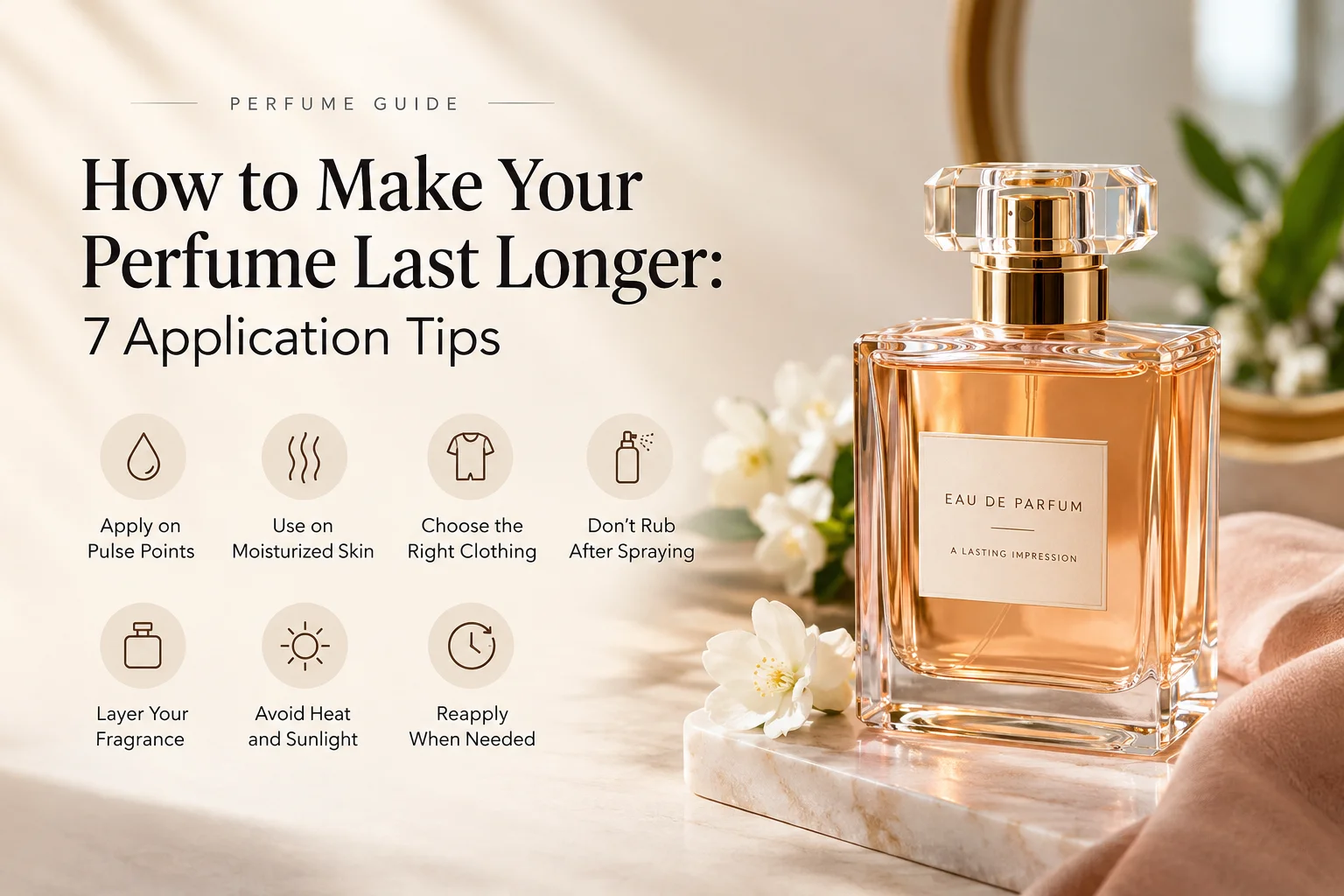
Spraying on moisturized skin extends wear significantly compared to dry skin. Pulse points (neck, wrists, inner elbows) help a scent release steadily through body warmth, while a light spray on clothing can outlast anything applied directly to skin, since fabric holds fragrance differently than skin does. Rubbing wrists together after spraying actually crushes top notes and speeds up fading, despite being a common habit.
Storage matters too. Heat, light, and temperature swings break down fragrance oils over time, so even a well-formulated perfume can start performing worse if it's kept somewhere hot or humid, like a bathroom shelf, rather than a cool, dark drawer or cupboard.
How to actually test longevity before buying
If longevity is a priority, don't judge a perfume in the first five minutes at a counter. Spray it, wait at least 30 minutes, then smell again— that's a far more honest picture of how it will actually behave. If possible, wear it for a few hours or even a full day before
committing to a full bottle, since a fragrance that smells incredible on first spray can behave completely differently by the afternoon.
A simple way to choose based on how long you need it to last
• For an 8+ hour workday or event: look for Extrait de Parfum concentrations with oud, amber, or heavy musk bases.
• For everyday wear with reasonable longevity: Eau de Parfum is usually the most practical, balanced option.
• For something light that you don't mind reapplying: Eau de Toilette or Eau de Cologne work fine, just expect to top up once or twice during the day.
In hot, humid climates specifically, leaning toward heavier, resin-based compositions — regardless of which concentration category you choose — will generally outperform fresh or citrus-forward fragrances built with cooler weather in mind. Brands formulating specifically for West African conditions, including Nigerian houses like Evason Profumo, tend to build around this reality from the start, which is worth knowing if longevity in real heat is your main concern.
FAQ
- Does a higher price always mean longer-lasting perfume?
Not necessarily. Price often reflects branding, packaging, and marketing as much as it reflects formulation. A moderately priced Eau de Parfum with a strong
resinous base can outlast an expensive fragrance built on light, fleeting notes.
2. Why does my perfume seem to disappear faster than advertised?
This is usually a combination of climate, skin type, and application rather than a flaw in the product. Hot or humid weather, dry skin, and
spraying without moisturizing beforehand can all significantly shorten wear time compared to ideal lab conditions.
3. Is it normal to reapply perfume during the day?
Yes, especially with lighter concentrations like Eau de Toilette or fresh, citrus-forward Eau de Parfum. A light reapplication in the early
afternoon is a completely normal habit, not a sign the perfume is low quality.
4. Do natural or niche perfumes last longer than mainstream designer perfumes?
Not automatically. Longevity comes down to concentration and note structure, not whether a brand is niche or mainstream.
Conclusion
How long a perfume lasts was never really about one number on a box. Concentration sets the starting point, but note structure, your own skin, the climate you're in, and even how you apply it all shape the final result. In a hot, humid environment especially, a heavier, resin forward composition will almost always outperform a delicate, fresh one, regardless of what the concentration label promises on paper.
The most reliable way to know how a fragrance will actually perform is still the simplest: test it on your own skin, give it time to develop, and judge it by how it wears through a real day, not by the first five minutes at a counter.
Explore Evason Profumo's collection, built with Nigeria's heat in mind, to find a fragrance designed to last.